Detailed guide
Quick answer
An executor is the person named in a will to deal with the estate of someone who has died. They find out what the person owned and owed, deal with inheritance tax, apply for probate if it's needed, collect the money, pay the debts and taxes, keep accounts, and then pay what's left to the beneficiaries. You don't need to be a lawyer to do it, but you do need to be organised and careful, because an executor can be personally liable for mistakes.
The executor's job, in order
- Secure the estate, in the first days and weeks. Find the will, register the death, protect the home and valuables, and tell the banks and pension payers.
- Value the estate, in the first weeks and months. Get date-of-death balances and valuations for everything the person owned and owed.
- Deal with inheritance tax, before applying for probate. Work out whether the estate is excepted or needs the IHT400, and pay any tax due.
- Apply for probate, once the values and tax are settled. Apply online or by post, and wait for the grant.
- Collect and pay, after the grant. Collect the money, sell or transfer property, and pay debts, tax and expenses.
- Account and distribute, usually once the six-month window for claims after the grant has passed. Prepare estate accounts, get the beneficiaries' approval, and pay out.
What executors do before probate
A lot of the work happens before the grant is issued, and it's where first-time executors most often underestimate the job.
- Find the will and any codicils, and check it's the latest one. How to find a will explains where to look.
- Register the death, or make sure it's been registered, and use Tell Us Once to inform government departments. See who to notify after a death.
- Protect the estate. Tell the home insurer if the house will be empty, secure valuables, and stop pension and benefit payments that would otherwise be overpaid.
- Agree who is acting. If there are several executors, decide who will apply and what the others will do.
- Build the estate's balance sheet. Write to each bank, pension provider and investment company for the value on the date of death, and list the debts.
- Deal with inheritance tax. Work out whether the estate owes any and which form it needs. See inheritance tax thresholds and rates.
What executors do after probate
With the grant, the executor has the legal authority to deal with everything in the estate.
- Send copies of the grant to each bank and organisation, and collect the money into an executor account.
- Sell or transfer property and investments.
- Pay the funeral, debts, any tax and the costs of the administration.
- Deal with the person's final income tax, and any tax on income or gains the estate makes while it's being dealt with.
- Advertise for unknown creditors with statutory notices before paying out. See how to deal with estate debts and creditors.
- Prepare estate accounts and pay the beneficiaries. See how to pay estate beneficiaries safely.
What an executor is responsible for
An executor's duty is to the estate and the people entitled to it. In practice, that means:
- acting in the beneficiaries' interests, not their own, even if they're a beneficiary too
- following the will, or the intestacy rules if the will doesn't cover something
- taking reasonable care with the estate's money and property
- keeping estate money separate from their own
- keeping records of what came in, what went out and why
- not distributing too early, before debts, tax and possible claims are dealt with
An executor isn't liable for the dead person's debts out of their own money. They can be liable for losses caused by their own mistakes. Executor liability explains where the risks are and how to avoid them.
Keeping beneficiaries informed
Executors don't have to report on every small task, but beneficiaries are entitled to a proper administration and to see the estate accounts at the end. Most disputes start with silence and confusion rather than wrongdoing. A short update every month or two, covering what's been done and what's next, prevents most of them.
Getting help
Executors often use professionals for parts of the job: a surveyor for the house valuation, a conveyancer for the sale, an accountant for tax returns, or a solicitor for a legal question. That's sensible. You stay responsible for the estate, so keep a note of the advice you were given and what you did about it.
Consider specialist advice if the estate:
- can't pay all its debts
- involves foreign assets, trusts or a business
- faces a dispute about the will or who is entitled
- includes a beneficiary who can't be found
If you don't want to be an executor
You don't have to act just because you're named in the will. If you haven't started dealing with the estate, you can give up the role, or step back and let another executor apply while keeping the right to act later. Executor power reserved vs renounced explains the difference.
Where Estate Suite helps
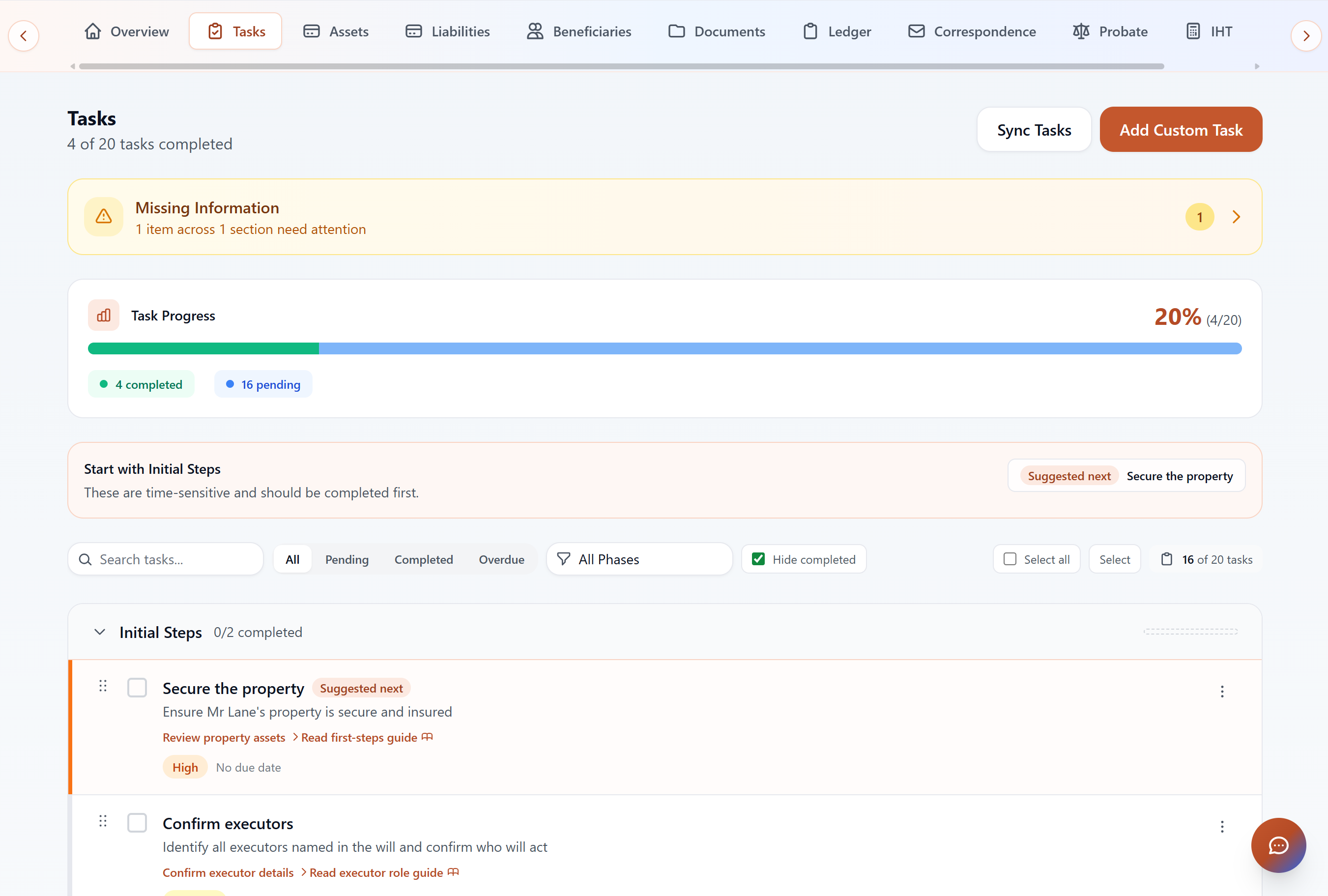
Estate Suite turns the executor's job into one ordered list, with the estate's assets, debts, tax position and records in the same place. Each step builds on the last, so by the time you reach the estate accounts, the figures are already there.
FAQ
Can an executor also be a beneficiary?
Yes. It's very common for a spouse or adult children to be both. The executor must still treat all beneficiaries fairly, and follow the will even where it doesn't favour them.
Does an executor get paid?
Not usually, unless they're a professional executor or the will allows payment. An executor can reclaim reasonable out-of-pocket expenses from the estate, such as postage, travel and certificates. Keep receipts.
Can an executor act before probate is granted?
Yes. An executor's authority comes from the will, so they can start collecting information, protecting the estate and arranging the funeral straight away. Most banks and buyers will still want to see the grant before releasing larger sums or completing a sale.
How long does an executor have to distribute the estate?
There's no fixed deadline, but an executor isn't required to distribute before the first anniversary of the death, known as the executor's year. Many executors also wait until six months after the grant, when the time limit for most claims against the estate under the Inheritance (Provision for Family and Dependants) Act 1975 has passed.
Can an executor refuse to act?
Yes, as long as they haven't already started dealing with the estate. Once they have, stepping away usually needs a court order.