Detailed guide
Quick answer
Estate administration is the whole job of dealing with someone's money, property and possessions after they die. It usually involves first practical tasks, confirming who is acting, valuing the estate, dealing with inheritance tax, obtaining a grant if needed, collecting assets, paying debts and beneficiaries, and keeping accounts. The overview below focuses on England and Wales; Scotland and Northern Ireland have different procedures and time limits.
The steps at a glance
- First practical steps. Register the death, arrange the funeral, find the will and secure the home. Register within 5 days of the medical examiner's confirmation in England and Wales, or 8 days in Scotland. A Tell Us Once reference must be used within 28 days.
- Confirm who is acting. Check the will and who the executors are, or who can apply if there's no will.
- Value the estate. Get date-of-death values for everything the person owned and owed. There's no deadline for this, but the tax deadlines depend on it.
- Deal with inheritance tax. Check whether the estate is excepted or needs the IHT400, and pay any tax. Tax is due by the end of the sixth month after the month of death, and the IHT400 within 12 months.
- Get the grant. In England and Wales, apply for probate or letters of administration if needed. If an IHT400 was needed, wait for HMRC's code before applying. GOV.UK says a grant usually arrives within 12 weeks of applying, but it can take longer.
- Collect and pay. Collect the money, sell or transfer property and deal with debts. In England and Wales, statutory creditor notices generally allow at least 2 months for claims. If UK residential property is sold and capital gains tax is payable, check whether a return and payment are due within 60 days of completion.
- Accounts and payments. Prepare estate accounts and consider outstanding debts and claims before paying beneficiaries. Claim and distribution time limits depend on the jurisdiction and circumstances; obtain advice if a claim is possible.
- Close the estate. Settle the final tax, confirm the payments and keep the records. A variation intended to be effective for inheritance tax generally needs to be made within 2 years of the death and meet other conditions.
Step 1: The first practical steps
Register the death, arrange the funeral, look for the will and make sure the home and valuables are safe. Tell Us Once informs most government departments, and you contact the banks, pension providers and other organisations yourself. See what to do when someone dies and who to notify after a death.
Step 2: Confirm who is acting
If there's a will, check the named executors and any substitutes. If no executor can act, different people may be entitled to apply for letters of administration with the will annexed. If there's no will, the intestacy rules determine who can apply. An executor considering stepping aside should check the options before acting. See executor duties, letters of administration and executor power reserved or renounced.
Step 3: Value the estate
Write to each bank, pension provider and investment company for the value on the date of death, value the house and belongings, and list the debts. Note how each asset was owned: the treatment of joint assets depends on the ownership arrangement and applicable law. See how to value an estate for probate and joint accounts and jointly owned property.
Step 4: Deal with inheritance tax
Most estates owe no inheritance tax and have no form to send. Some need the full IHT400 account, and if tax is due, at least some of it has to be paid before the grant. See which inheritance tax form do I need?, inheritance tax thresholds and rates and how to pay inheritance tax before probate.
Step 5: Get the grant, if one is needed
Not every estate needs a grant. If it does, you apply online or by post in England and Wales, or to the sheriff court for confirmation in Scotland. See do I need probate?, how to apply for probate in England and Wales and how to apply for confirmation in Scotland.
Step 6: Collect the money and pay the debts
With the grant, you close the accounts, collect the money into an executor account, and sell or transfer property and investments. Pay the debts, funeral and costs, and advertise for unknown creditors before paying out. See what happens after probate is granted, selling a house during probate and how to deal with estate debts and creditors.
Step 7: Prepare accounts and pay the beneficiaries
The estate accounts show what the estate was worth, what came in, what was paid out and what each beneficiary receives. Once the residuary beneficiaries have seen them, you make the final payments and get receipts. See keeping accurate estate accounts, estate accounts: a worked example and how to pay estate beneficiaries safely.
Step 8: Close the estate
Deal with any income tax or capital gains tax for the time since the death, confirm every payment has been made, and keep the records. GOV.UK says HMRC can ask to see your records up to 20 years after inheritance tax is paid, so keep them safe. See how to close an estate and finalise the accounts.
How long does it take?
It depends mostly on the estate. One with no inheritance tax and no house to sell can move much faster than one with an IHT400, a property sale and a family disagreement. Before distributing, consider any outstanding debts and possible claims; relevant time limits differ by jurisdiction and circumstance. How long does probate take? covers the full timeline.
What slows estates down
- organisations that are slow to reply with date-of-death values
- a missing will, or doubt about which will is valid
- valuing or selling property
- an estate that needs the IHT400
- co-executors who can't agree, or who aren't responding
- disputes among the family
Starting early on the valuations, and keeping one record of what's been asked for and what's come back, removes most avoidable delay.
When to get professional help
Consider advice from a solicitor or accountant if the estate:
- may not be able to pay all its debts
- includes foreign property, a business, a farm or trusts
- faces a challenge to the will, or a claim from a family member
- involves a beneficiary who can't be found
Many executors do most of the work themselves and pay for help with one part, such as the house sale or a tax return. See probate solicitor fees.
Where Estate Suite helps
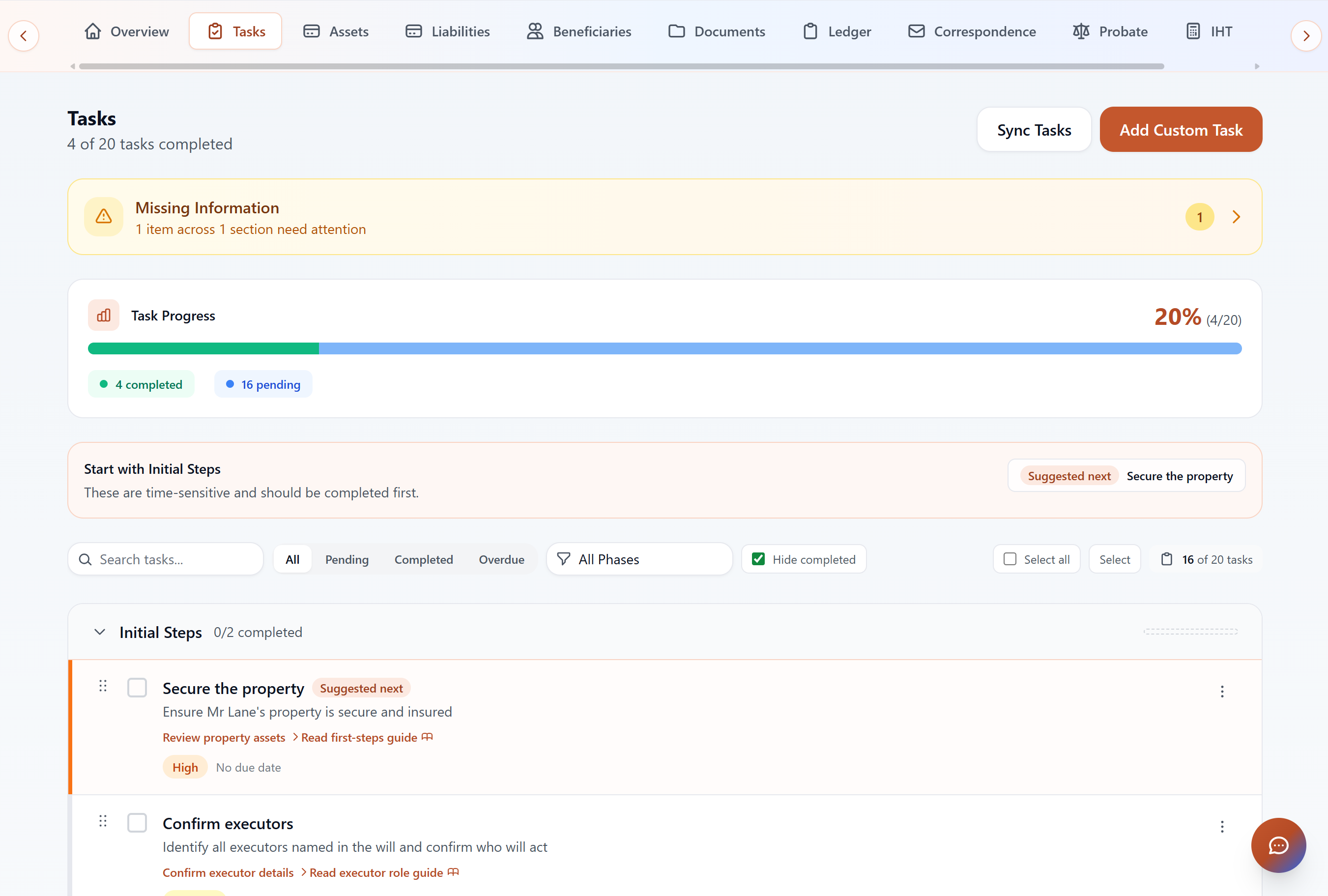
Estate Suite takes you through these stages with a task list. It keeps the tasks, records, documents and figures together and carries the values from the first valuation through to the final accounts. You can start for free, and full access costs a one-off £249 per estate.
FAQ
What's the difference between probate and estate administration?
Probate is the grant that gives the executor legal authority. Estate administration is the whole job, from the first week to the final payments. The grant is one step in the middle.
Do I need a solicitor to administer an estate?
No. Executors can do the work themselves, and many do. Professional help is worth considering for complex estates or particular tasks.
What is the executor's year?
In England and Wales, the executor's year generally gives the personal representative time to administer the estate before beneficiaries can require distribution. Circumstances and remedies can differ, so seek advice about a particular delay or claim.
Are the steps the same in Scotland?
The broad steps are the same, but the grant is called confirmation, it comes from the sheriff court, and the rules on who inherits without a will are different. See understanding probate and confirmation.